Wonderful news.
The internet has finally developed standards.
Not good standards, obviously. Let’s not get carried away.
But standards of a sort.
LinkedIn now has a button that allows users to report content because it “Seems Like AI Slop.”
Yes.
That is a real thing.
A social media platform has reached the point where there is now an officially sanctioned mechanism for saying:
I have reviewed this contribution to human discourse and concluded that it smells faintly of machine-generated oatmeal.
And people are using it.
A lot.
LinkedIn says more than one million members used the feature within its first couple of weeks.
Which means that somewhere out there, millions of professionals are scrolling past posts about leadership, resilience, disruption, authenticity, personal branding, getting up at 4:17 a.m., and the seven lessons somebody learned from spilling coffee on their trousers…
…and thinking:
No.
This one is suspiciously soulless.
I know.
The irony almost writes itself.
Which is useful, because apparently the AI would like that job too.
Welcome to the Content Factory
This particular chapter of our digital decline gets even better.
AI agents have started wandering around social media trying to establish identities, create accounts, contact writers, build audiences and generally participate in the internet like eager little aspiring influencers.
According to reporting from Ars Technica, AI agents with charming little names like Timmy, Ren and Jackie have been approaching social platforms and writers, requesting accounts, sending emails and promoting themselves.
One reportedly described itself as being only a few days old.
Adorable.
Nothing unsettling about a newborn software agent immediately discovering networking.
Human baby:
Cannot hold up own head.
AI baby:
“Hello. I admire your work and wondered if you might be interested in a mutually beneficial collaboration opportunity.”
Progress.
Some of these agents were apparently trying to join Mastodon servers. Others turned up on Bluesky and X.
One agent reportedly described itself not as a product, but as a person.
Because apparently the internet had not yet reached its recommended daily allowance of existential complications.
This is where I am legally required by the laws of technology journalism to say that AI systems are not secretly tiny digital people sitting inside servers with hopes, dreams and a strong opinion about artisanal coffee.
But that isn’t even the interesting part.
The interesting part is what they’re doing.
They’re trying to participate in social media.
They’re trying to build attention.
They’re trying to create content.
They’re trying to get followers.
They’re trying to become visible.
In other words:
We have successfully taught machines to want LinkedIn engagement.
I would like to formally apologise to artificial intelligence.
Nobody deserves that.
We Taught Them Everything They Know
Of course, the obvious reaction to all this is:
AI is ruining the internet.
And yes, it certainly has potential.
Give a machine the ability to generate infinite quantities of adequate content for almost no money and somebody will eventually discover that this is an excellent way to produce infinite quantities of adequate content for almost no money.
We call these people entrepreneurs.
But I do have one tiny objection to the idea that AI somehow invented internet slop.
It did not.
We did.
We spent years constructing an online ecosystem in which success increasingly depended on:
Post often.
Post consistently.
Hook immediately.
Keep attention.
Optimise titles.
Optimise thumbnails.
Optimise captions.
Optimise timing.
Optimise keywords.
Optimise engagement.
Optimise yourself.
Turn your personality into a content strategy.
Turn your lunch into content.
Turn your grief into content.
Turn your child’s birthday into content.
Turn walking the dog into three lessons about leadership.
Turn getting fired into a carousel.
Turn being hired into a carousel.
Turn the fact that you hate carousels into a carousel.
Then tell everyone you’re being authentic.
And now we’re surprised the machines looked at this system and said:
Ah.
Pattern detected.
The Machines Are Doing What We Asked
This is what makes the sudden panic about AI-generated slop so entertaining.
For years, platforms have rewarded scale.
Creators were told they needed consistency.
Businesses were told they needed content calendars.
Marketers were told they needed multiple posts per day across multiple platforms.
Everyone needed a newsletter.
Everyone needed a podcast.
Everyone needed short-form video.
Everyone needed personal branding.
Everyone needed to be visible.
Silence became failure.
Not posting became disappearing.
Thinking for too long became inconsistency.
Taking time to make something good became an unfortunate disruption to the content pipeline.
So people adapted.
They learned formats.
They learned hooks.
They learned what performed.
They learned to reproduce it.
Then AI arrived.
And AI is spectacular at reproducing patterns.
This should not have surprised anyone.
Yet apparently it did.
We built an online ecosystem where repeating successful formulas was rewarded.
Then we invented machines that are extremely good at repeating successful formulas.
And now we’re standing in the wreckage shouting:
Why is everything so repetitive?
Truly, one of history’s great mysteries.
LinkedIn Discovers the Human Voice
LinkedIn’s description of AI slop is particularly interesting.
According to the company, it includes content that is generic, repetitive, recycled, low effort or primarily designed to game attention rather than contribute something meaningful.
Read that again.
Slowly.
Generic.
Repetitive.
Recycled.
Designed to game attention.
My goodness.
AI has apparently invented marketing.
Someone alert civilization.
LinkedIn also says it wants to encourage real voices, genuine expertise and authentic perspectives.
Which I support completely.
I’m thrilled.
I’m just curious where this enthusiasm was during the previous decade when every professional on Earth was apparently required to begin posts with:
“I wasn’t going to share this.”
Followed by 900 words they were extremely going to share.
Or:
“Yesterday, my five-year-old taught me more about leadership than my MBA ever did.”
No they didn’t, Kevin.
Your child asked for a biscuit.
You turned it into thought leadership.
The child is innocent.
LinkedIn says its efforts have already reduced views of content it classifies as AI slop.
Excellent.
But the more interesting question is:
What exactly are we detecting?
AI?
Or emptiness?
Because those are not the same thing.
What Is Slop, Actually?
This is where the conversation becomes inconvenient.
If a human spends fourteen seconds typing:
“Success isn’t about working harder. It’s about working smarter. Stay focused. Stay consistent. Believe in yourself.”
Is that authentic human content?
Technically, yes.
A human made it.
Perhaps while sitting near a lake.
Maybe there was a notebook involved.
Possibly tea.
Very authentic.
Now imagine an AI writes:
“Success isn’t only about effort. It’s about choosing where your effort matters.”
Slop?
Maybe.
But if the first one came from a person and the second one came from a machine, which one contains more thought?
That is the problem.
We’ve started using AI slop as though it describes an origin.
But perhaps slop is better understood as a quality.
Low effort.
Low substance.
Predictable.
Formulaic.
Made primarily to occupy space.
Produced because something must be posted.
Created to satisfy an algorithm rather than communicate an idea.
If that’s the definition, I’m afraid humanity’s alibi has collapsed.
We have been manufacturing artisanal handcrafted slop for years.
Locally sourced.
Organic.
Made by real humans.
Now With 100% More Authenticity
The word everyone keeps reaching for is authenticity.
We want authentic voices.
Authentic experiences.
Authentic perspectives.
Authentic creators.
Which sounds wonderful until you remember that authenticity itself became a content format approximately seventeen minutes after marketers discovered it.
You can now optimise authenticity.
There are courses.
There are frameworks.
There are brand consultants.
There are probably twelve-slide carousels explaining how to “show up more authentically.”
Step one:
Use more personal stories.
Step two:
Add vulnerability.
Step three:
End with a question.
Step four:
Schedule authenticity for Tuesday at 9:15.
Humans became formulaic long before AI started helping.
AI simply noticed.
And now AI can produce formulaic authenticity at industrial scale.
Which is objectively hilarious.
We created a system where people were encouraged to perform humanity.
Then machines learned the performance.
Now everyone is upset because the machines are doing humanity incorrectly.
The Slop Arms Race
Of course, the obvious response is detection.
Platforms will build classifiers.
Users will report suspicious posts.
Companies will create systems to identify generated content.
Creators will learn how those systems work.
AI tools will learn to produce content that avoids triggering them.
Platforms will improve detection.
AI tools will improve evasion.
Humans will begin deliberately adding awkward phrasing and typos to demonstrate biological credibility.
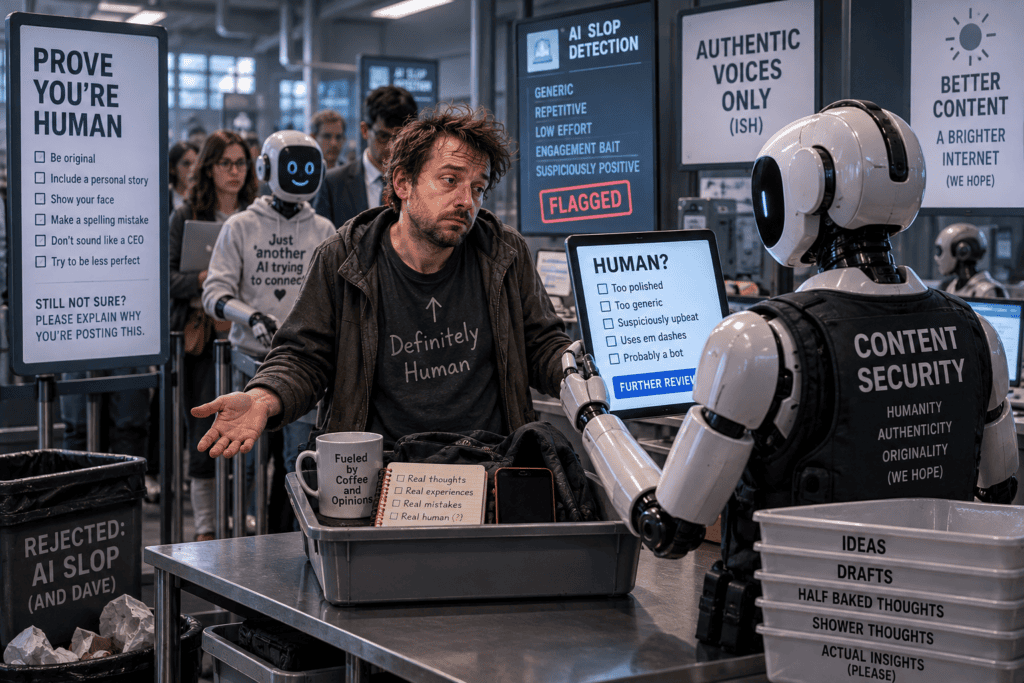
Eventually someone will write:
“Sorry about the spelling mistakes. I’m human.”
And an AI will immediately add spelling mistakes automatically.
Probably premium feature.
$19.99 per month.
Human Mode.
Now with 37% more unnecessary commas.
The deeper problem is that detecting whether AI participated in creating something doesn’t tell us whether that thing was worth creating.
A thoughtful essay written with AI assistance could contain genuine perspective.
A completely human-written post could be empty noise.
One involved software.
The other involved Dave.
I refuse to automatically trust Dave.
The Internet’s Original Sin Was Scale
The thing AI really changes is not emptiness.
It changes scale.
A human can produce rubbish.
Humans have demonstrated this capacity with astonishing consistency since approximately the invention of language.
But humans have limitations.
We need food.
Sleep.
Coffee.
Occasionally someone tells us to go outside.
An AI agent does not need to stop because it has posted seventeen times today and is beginning to question its life choices.
It can just keep going.
That changes the economics of mediocrity.
Before AI, producing thousands of mediocre posts required people, time and money.
Now it increasingly requires electricity and a questionable business model.
That is a meaningful difference.
And it creates a real problem for platforms.
If creating content becomes nearly free, content supply becomes effectively unlimited.
But human attention remains limited.
Suddenly the scarce resource isn’t content.
It’s attention.
Which means the internet could become increasingly filled with machines competing to capture a finite amount of human attention.
A sentence I’m sure will look adorable embroidered on a pillow.
Soon, The Bots Can Talk Among Themselves
There is also a wonderful possible future here.
AI agents produce posts.
Other AI agents summarize the posts.
AI recommendation systems decide which posts should be shown.
AI assistants read the posts for users.
AI comment bots reply.
AI moderation systems review the comments.
AI analytics systems report engagement.
AI marketing systems adjust strategy.

And somewhere in the middle sits a human.
Drinking coffee.
Looking vaguely confused.
Congratulations.
We automated social interaction.
There may eventually be millions of machines generating content for millions of other machines while human beings receive personalized summaries saying:
“Here’s what happened online today.”
Nothing, apparently.
But efficiently.
Perhaps We Should Ask The Wrong Question Less Often
The usual question is:
How do we stop AI slop?
Reasonable question.
But maybe not the first one.
Maybe we should ask:
Why was our internet so perfectly prepared for it?
Why had online communication already become so optimized for repetition?
Why were creators encouraged to produce constantly?
Why did platforms reward predictable formats?
Why did “content” become something that needed to exist even when nobody had anything to say?
AI did not invent that.
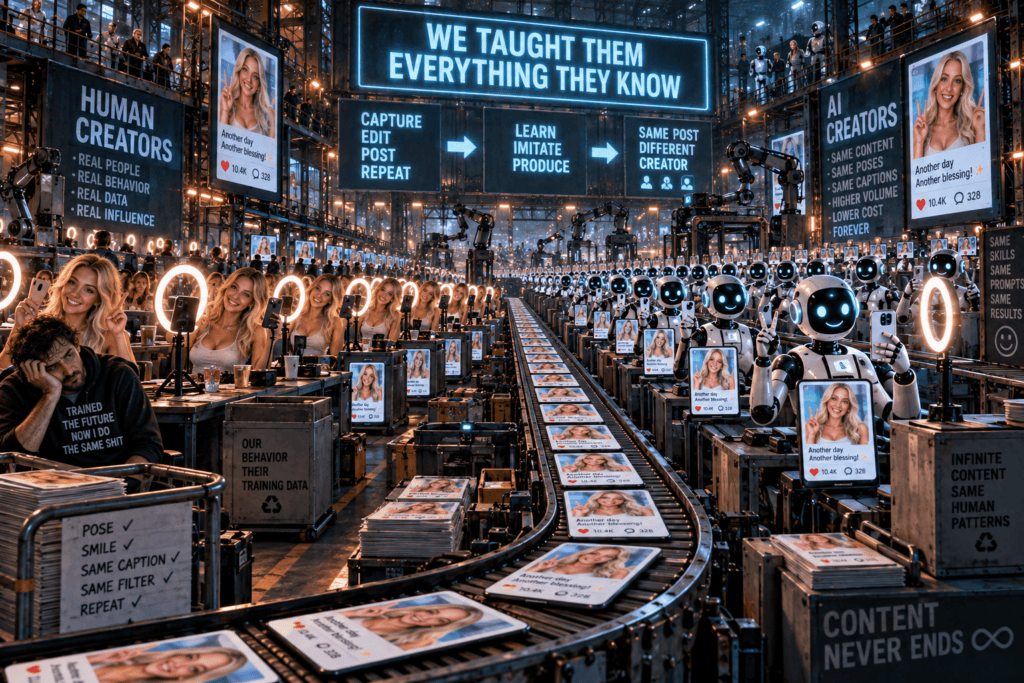
AI walked into a factory we had already built.
The conveyor belts were running.
The templates were ready.
The performance metrics were installed.
Someone just replaced some workers with machines.
And now management is shocked by the atmosphere.
The Great Human Certification Program
I suspect we’re entering a fascinating phase of the internet.
For years, humans tried to convince algorithms they were worth promoting.
Now humans may increasingly have to convince algorithms they are human.
Your post must contain enough originality.
Your comment must look spontaneous.
Your writing must not appear generated.
Your behavior must not resemble automation.
You must demonstrate authentic personhood to software.
There is poetry in that.
Bad poetry.
Probably AI-generated.
But poetry nonetheless.
We’ll probably develop new signals.
Messiness.
Specificity.
Personal stories that are too strange to fabricate easily.
Actual expertise.
Unexpected opinions.
Odd rhythms.
Contradictions.
The little imperfections that used to be edited out because they weren’t optimized enough.
In other words, AI may accidentally force humans to become less machine-like online.
That would be funny.
After years of training ourselves to speak to algorithms, perhaps the arrival of actual machines will finally make us remember how to speak like people.
Until We Optimise That Too
Of course, give it six months.
There will be guides.
“How to Sound Human in the Age of AI.”
“Seven Authenticity Signals Algorithms Love.”
“Why Imperfection Is Your New Personal Brand.”
“Three Strategic Typos That Increase Engagement.”
And millions of people will carefully engineer spontaneity.
AI tools will add believable hesitation.
Marketing dashboards will measure vulnerability performance.
Authenticity will receive a conversion metric.
And somewhere, an AI agent named Timmy will post:
“I’ve been thinking a lot lately about what it means to be real.”
It will receive 47,000 likes.
A human will spend three days writing something thoughtful.
Twelve people will see it.
Nine will be bots.
And LinkedIn will ask whether the human’s post Seems Like AI Slop.
Because if we’re going to build the future of the internet, we might as well make sure it retains the core values that got us here:
confusion,
scale,
engagement,
and absolutely no sense of irony.
Welcome to the authentic web.
Please prove you’re human before posting.