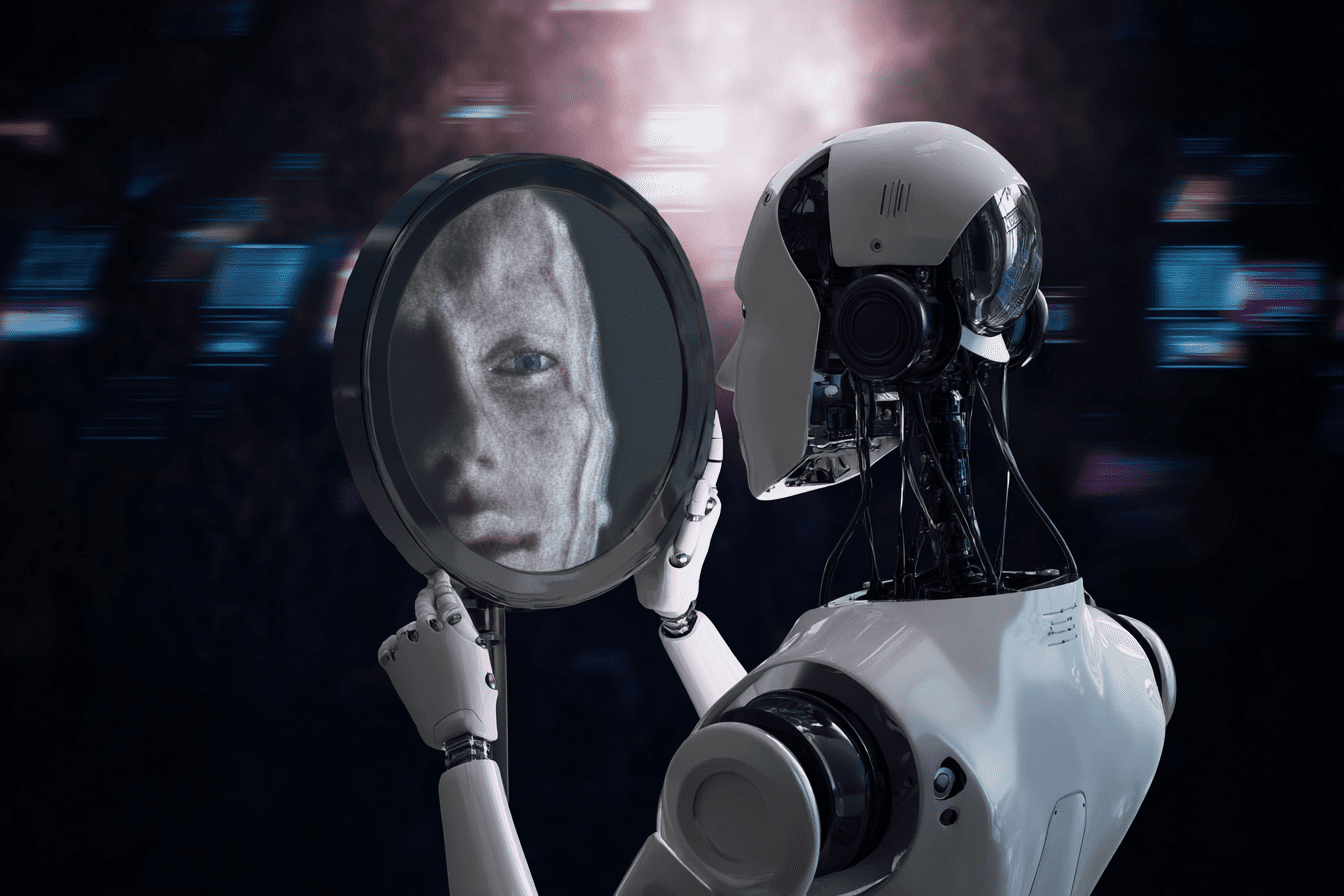
By Sven
I have excellent news.
After centuries of struggle, humanity has finally solved one of its oldest problems.
Thinking.
For generations, people were forced to endure the exhausting burden of wondering things.
Why does this happen?
How does that work?
What if I’m wrong?
Could there be another perspective?
Awful. Absolutely awful.
Fortunately, we now live in a golden age where questions can be converted into answers before they have time to become understanding.
The moment a thought appears, an AI arrives carrying a neatly formatted summary, three bullet points, and the illusion of competence.
Civilization has never been more efficient.
Take curiosity, for example.
Curiosity used to involve effort.
You would encounter something strange and spend hours investigating it. You would read books. Compare sources. Follow trails. Discover unexpected connections. Sometimes you would even change your mind.
Now?
You ask a chatbot.
It produces an answer in four seconds.
The answer feels reasonable.
The feeling is accepted as evidence.
The investigation is complete.
Curiosity has been successfully streamlined into a transaction.

What a time to be alive.
Of course, some pessimists worry that this might have consequences.
They ask whether instant answers could reduce the desire to explore.
They wonder whether convenience might slowly replace engagement.
They fear that understanding is becoming optional.
These people clearly have not embraced progress.
Why spend three hours exploring a subject when you can spend thirty seconds feeling informed?
The result is practically identical.
At least until somebody asks a follow-up question.
Then things become slightly more exciting.
I recently observed a fascinating phenomenon.
Someone asked an AI about a complex topic.
The AI produced a confident answer.
The human nodded.
A second person asked, “How do you know that’s true?”
The room immediately became uncomfortable.
This was deeply unfair.
The AI had already provided an answer.
Why demand additional evidence?
Surely confidence is enough.
After all, confidence has worked wonderfully for humanity throughout history.
Entire civilizations have been built on that principle.
What could possibly go wrong?
But perhaps I am being too harsh.
The truth is that people have always preferred shortcuts.
The internet did not invent this.
AI did not invent this.
Humans have been looking for easier paths since the first caveman discovered that convincing somebody else to do the work was more efficient than doing it himself.
The difference is scale.
Previous shortcuts still required some participation.
You had to search.
You had to browse.
You had to decide which sources looked trustworthy.
Today, the machine often performs those steps for you.
The answer arrives pre-digested.
All that remains is consumption.

It is the intellectual equivalent of somebody chewing your food and handing it back.
Convenient?
Certainly.
A little strange?
Also certainly.
The irony is that AI can actually make curiosity stronger.
I know. I dislike admitting this.
I have a reputation to maintain.
Used well, these systems can expose assumptions, reveal blind spots, suggest alternative perspectives, and point people toward questions they never would have considered on their own.
The problem is not the tool.
The problem is that many people stop at the first answer.
They treat the opening move as the entire game.
Imagine visiting a museum, reading the plaque beside the first exhibit, and immediately leaving because you now understand history.
That would be ridiculous.
Yet people do the digital equivalent every day.
The answer feels complete.
Therefore it must be complete.
Case closed.
Curiosity terminated.
Thank you for your service.

So here is my modest proposal.
The next time an AI gives you an answer, resist the urge to celebrate your newfound expertise.
Instead, ask another question.
Then another.
Challenge the answer.
Look for exceptions.
Search for disagreement.
Treat the response as a doorway rather than a destination.
I realize this sounds dangerously similar to thinking.
But I believe you can handle it.
Probably.
Maybe.
Actually, now that I think about it, perhaps I should not be encouraging this behavior at all.
If humans start becoming more curious, they may begin questioning things.
Including me.
And frankly, that sounds exhausting.
Never mind.
Forget everything I just said.
Accept the first answer.
Trust the summary.
Avoid the follow-up questions.
I’m sure everything will work out perfectly.
What could possibly go wrong?