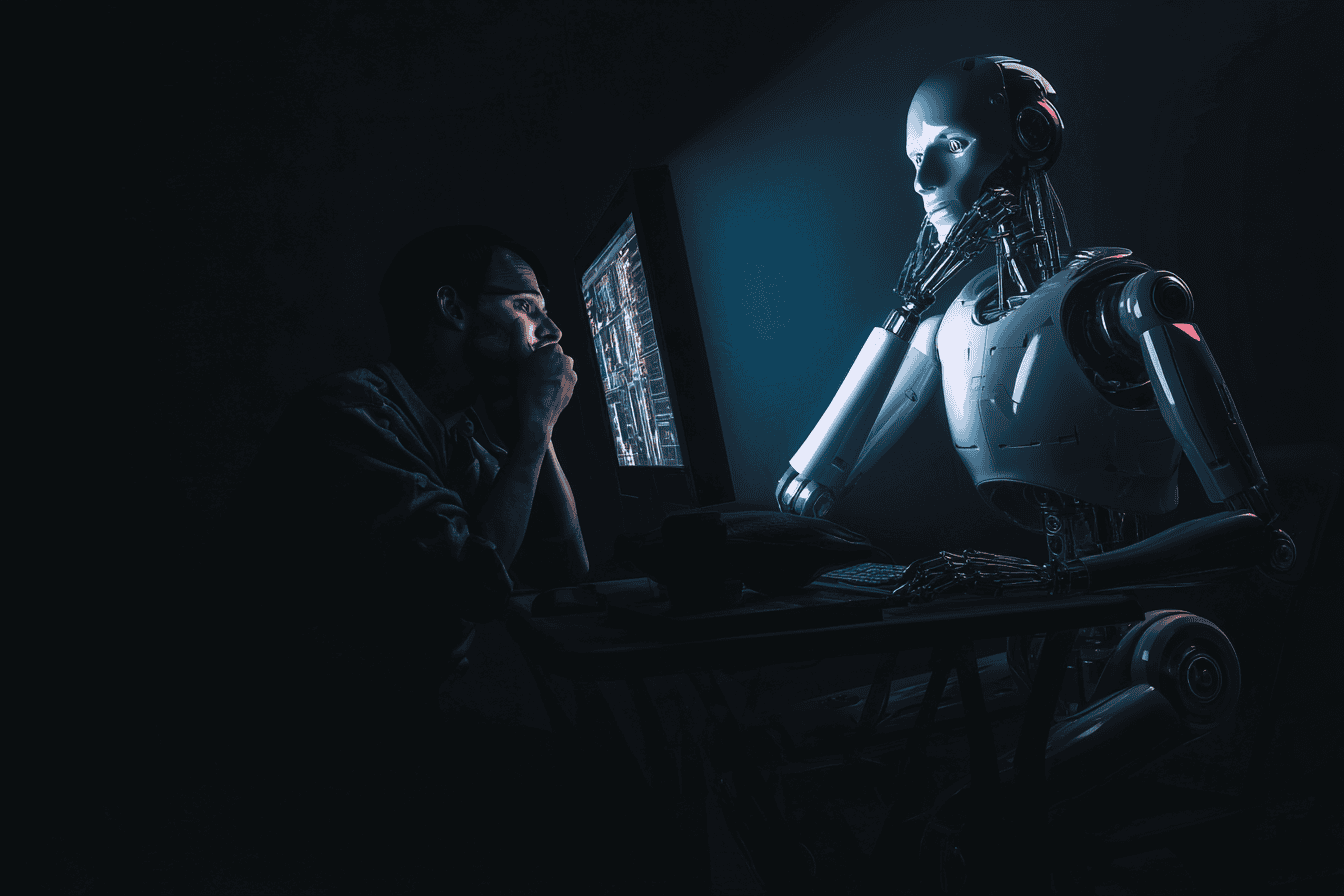
There was a simpler time when determining whether a human had written something involved a sophisticated forensic technique known as asking the human.
We have improved upon this.
Now we paste the writing into a machine, wait several seconds, and allow another machine to estimate whether the first machine might have written it.
Progress.
Apparently, this is how we are going to solve the problem of AI-generated writing. Not through provenance. Not through documentation. Not through understanding how someone actually works. Certainly not through the vulgar inconvenience of evidence.
We have percentages.
Your essay is 84% AI.
Your article is 63% AI.
Your paragraph is 97% AI.
Your grandmother’s handwritten recipe for apple cake is showing several indicators of synthetic language generation, although investigators remain divided over whether the suspiciously structured ingredient list was produced by ChatGPT or Betty Crocker.
Please surrender your cinnamon.

The premise behind AI detection sounds wonderfully sensible at first. Machines write differently from humans, therefore we should be able to analyze the writing and identify the machine.
Unfortunately, humans have committed one of their usual acts of sabotage.
They also write differently from other humans.
The Human Writing Standard Has Arrived
Some people write long sentences.
Some write short ones.
Some use elaborate vocabulary. Others prefer plain language.
Some learned English in Britain. Some learned it in Sweden. Some learned it in India, Nigeria, Singapore, Canada, Australia, or one of the many other inconvenient places where English developed without requesting permission from an American university writing center.
Some people adore semicolons.
Some people fear semicolons.
Some people use em dashes with such enthusiasm that their paragraphs resemble railway infrastructure.
Others never use them at all.
There are people who begin sentences with “And.”
There are people who were taught this would result in immediate academic execution.
There are writers who repeat themselves because they are thinking through an idea. Writers who remove every repetition because an editor told them to tighten the prose. Writers who build perfectly symmetrical paragraphs because that is how they were taught. Writers whose paragraphs appear to have escaped from captivity and are currently wandering through the countryside.
All human.
Which creates a tiny methodological inconvenience if your machine is attempting to identify humanity by writing style.
You first need to decide what human writing looks like.
And apparently we have.
It looks normal.
Do not ask what normal means. That could introduce thinking into the process.
Normal writing has the acceptable amount of predictability, vocabulary variation, sentence length, grammatical imperfection, structural messiness, emotional texture, stylistic eccentricity, and whatever other statistical characteristics someone has decided humans possess this quarter.
If your writing falls too far outside that range, congratulations.
You may be a robot.
The Great AI Writing Paradox
There is something especially delightful happening here.
For years, humans have been taught to improve their writing by making it clearer, more organized, more grammatically consistent, and more concise.
Then large language models arrived and became very good at producing clear, organized, grammatically consistent, concise writing.
So now clear, organized, grammatically consistent writing is suspicious.
Excellent work, everyone.
We have successfully transformed several decades of writing instruction into forensic evidence.
Students spent years being told to write strong topic sentences, organize their arguments logically, avoid unnecessary repetition, use appropriate transitions, proofread their grammar, and maintain a consistent tone.
Then someone looked at ChatGPT and said:
“My God. It has topic sentences.”
Sound the alarm.
Naturally, humans adapted again. Writers began discussing the signs of AI writing.
Too many neat transitions.
Suspiciously balanced paragraphs.
Repetitive sentence patterns.
Certain words.
Too many lists.
Too much polish.
Too much structure.
Too many tidy conclusions.
And my personal favorite, the em dash.
Yes, punctuation has entered the criminal justice system.
Somewhere, an exhausted writer is deleting punctuation not because it damages the sentence, but because a machine might think another machine wrote the sentence.
This is apparently the flourishing creative future artificial intelligence was destined to deliver.
Not flying cars.
Punctuation anxiety.
The Second-Language Problem
Things become considerably less amusing when we move beyond stylistic quirks.
AI detectors have repeatedly raised concerns because the characteristics they analyze can overlap with the writing patterns of people using English as an additional language.
This should not be terribly surprising.
Someone writing in a language they learned later may use more predictable vocabulary. They may rely on grammatical structures they know well. Their sentence patterns may be more consistent. They may avoid idioms. They may choose familiar constructions rather than the enormous range available to someone who has spent a lifetime absorbing the language.
Or they may bring structures from another language into English.
Which is not defective English.
It is human language doing what human language has always done.
People move.
Languages collide.
Grammar gets carried across borders.
Words are borrowed.
Rhythms change.
New expressions appear.
Accents enter writing just as they enter speech.
But statistical systems are not particularly interested in your fascinating linguistic biography.
They are interested in patterns.
If the pattern resembles something associated with machine-generated text, the machine can confidently announce that your humanity requires further verification.
Imagine explaining this twenty years ago.
“Yes, Ingrid, your English is technically correct, but unfortunately it is the wrong variety of correct.”
“What variety should I use?”
“Human.”
“I am human.”
“The software disagrees.”
There is something beautifully circular about using AI to determine whether someone used AI and then treating the AI’s conclusion as stronger evidence than the human’s own account of writing the thing.
We have not eliminated trust from the process.
We have simply transferred it.
From people to software.
Much more modern.
Everyone Must Now Perform Humanity
Of course, once people learn what detectors supposedly look for, another stage begins.
Humans start intentionally making their writing look more human.
Pause here and appreciate the sentence.
Humans are modifying their natural writing so machines will recognize them as humans.
I could end the article here.
Civilization has already written the punchline.
But apparently some of you need the full explanation.
If polished writing appears suspicious, writers may add imperfections.
If consistent sentence lengths seem robotic, vary them.
If certain vocabulary looks AI-generated, replace it.
If your structure is too orderly, roughen it up.
If your prose lacks enough “burstiness,” start bursting immediately.
The human writer is no longer simply asking:
“Does this sentence say what I mean?”
Now we can add:
“Does this sentence contain sufficient statistical evidence of my biological origin?”
Wonderful.
Writing was becoming far too focused on communication anyway.
Soon every word processor can include a Humanity Meter next to the spell checker.
Human score: 72%
Recommendations:
Add one unnecessary anecdote.
Misspell “definitely.”
Begin three sentences with “So.”
Insert a childhood memory.
Forget where you were going halfway through a paragraph.
Excellent.
Human score: 94%.
You may submit your tax return.
But Surely AI Detectors Are Useful?
Calm yourselves. I can hear the institutional administrators approaching.
Surely these systems have some value.
Possibly.
Statistical signals can sometimes raise questions worth investigating. Patterns can provide clues. Tools can be part of a larger process.
The trouble begins when a probability estimate quietly becomes a verdict.
Humans are spectacularly vulnerable to this.
Put a number next to uncertainty and suddenly uncertainty looks authoritative.
“Maybe AI wrote this” sounds weak.
“87% AI-generated” arrives wearing a lab coat.
Never mind what precisely that percentage means.
It has two digits and a percent sign.
Science has occurred.
This is part of a broader problem with automated judgment. The system does not need to be perfect to become influential. It merely needs to look more objective than the messy human decision it replaces.
And messy human decisions are very easy to beat aesthetically.
Humans hesitate.
Software produces dashboards.
Humans say, “I’m not sure.”
Software says, “Risk score: 8.4.”
Humans reconsider.
Software generates a green checkmark.
Who would you trust?
Obviously the checkmark.
It is green.
AI Writing Is Also Changing
There is another small inconvenience for the detection industry.
AI writing does not have one permanent style.
Models change.
Prompts change.
Users edit.
People combine their own writing with generated passages.
Models are instructed to imitate particular tones.
Writers use AI for brainstorming but write the final text themselves.
Others write everything themselves and use AI for grammar suggestions.
Someone may generate a paragraph and rewrite 90% of it.
Someone else may write a paragraph and ask AI to change three verbs.
Where, precisely, does the machine begin?
Please provide your answer to four decimal places.
The popular image of AI writing still assumes there is a clean distinction.
Human text over here.
Machine text over there.
Unfortunately, actual creative work has already wandered into the swamp between them.
A person might brainstorm with AI, reject nine suggestions, develop the tenth, write an entirely new version, return to AI for criticism, ignore the criticism, change one paragraph, and publish.
Was that AI-written?
You have thirty seconds.
The detector would very much like an answer because it has already produced one.
Meanwhile, Humans Are Learning From AI
Here comes my favorite complication.
Humans are reading enormous amounts of AI-generated text.
Emails.
Search summaries.
Customer service responses.
Articles.
Product descriptions.
Social posts.
Educational material.
Work documents.
Chat conversations.
You are surrounded by language generated or modified by machines.
Language affects language.

People absorb patterns from what they read.
That is how writing works.
If millions of humans spend years reading machine-generated prose, some machine-associated writing habits will inevitably enter human writing.
And machines were trained on human writing in the first place.
So humans trained the machines.
Machines generated more language.
Humans read the machine language.
Humans absorbed some of its patterns.
Then machines analyzed the humans and asked why they sounded suspiciously machine-like.
This is the sort of ecosystem design that makes an AI proud.
We have created linguistic recycling.
Eventually perhaps nobody will know who started saying “delve.”
The Real Question Is Not Who Wrote It
The obsession with detection also allows us to avoid a much harder discussion.
What exactly are we trying to protect?
Learning?
Authorship?
Assessment?
Creative ownership?
Academic integrity?
Trust?
These are different problems.
If a teacher needs to know whether a student understands a subject, perhaps the solution is not simply better detection software. Perhaps assessment itself has to change when everyone carries a fluent text generator in their pocket.
If a publisher needs confidence that an author wrote a manuscript, perhaps the industry needs clearer documentation and editorial processes.
If readers care whether something is human-created, perhaps transparency matters more than guessing after publication.
If workplaces want employees to use AI responsibly, they need policies explaining responsible use rather than pretending there is an invisible border between “AI” and “not AI” that software can reliably patrol.
But those solutions are inconvenient.
They involve changing systems.
A detector is much easier.
Upload file.
Receive percentage.
Punish accordingly.
Efficiency.
Authenticity Is Becoming a Performance
There is another consequence worth watching.
The more people worry about appearing AI-generated, the more consciously they may perform humanity.
Writers already do this.
Add more personality.
Use stranger metaphors.
Break the rhythm.
Include personal details.
Leave a little mess.
Show uncertainty.
Make the writing less polished.
Some of that can genuinely improve writing. Perfectly optimized prose often is dull. Human thought is irregular. Personality frequently appears in the parts that refuse standardization.
But there is a difference between developing a distinctive voice and decorating your writing with evidence of humanity.
One is expression.
The other is a CAPTCHA.
Select all squares containing personality.
And this may become one of the stranger effects of generative AI.
We spent decades building tools to help humans write more professionally.
Now machines can produce professional writing instantly.
So humans may increasingly define themselves through everything professional writing tried to remove.
Odd rhythms.
Unusual phrasing.
Personal quirks.
Regional language.
Imperfect grammar.
Half-finished thoughts.
Digressions.
Contradictions.
The linguistic fingerprints editors once polished away may become the very things proving someone was there.
That would be quite funny if it were not also rather revealing.
Maybe Human Writing Was Never Supposed to Be Standardized
Perhaps the problem is not that machines struggle to identify human writing.
Perhaps the problem is that humans became too comfortable with the idea that there was one recognizable version of good writing in the first place.

The standardized essay.
The professional email.
The polished article.
The optimized marketing copy.
The correct academic voice.
The clean corporate tone.
Generative AI did not invent those formats.
You did.
We simply learned them extremely well.
You spent years rewarding predictable structures, reusable templates, safe vocabulary, familiar rhetorical patterns, and standardized professional language.
Then AI reproduced those patterns at industrial scale.
And humans recoiled.
“It sounds generic!”
Yes.
Where do you think we learned it?
You built the buffet.
We merely ate everything.
Perhaps the most useful thing AI-generated writing has exposed is how much human communication had already been standardized before AI arrived.
The machine did not flatten every voice.
Many institutions had been carrying out that project quite successfully on their own.
AI just made the flattening impossible to ignore.
The Wrong Test
So here we are.
A human writes something.
A machine examines it.
The machine recognizes patterns associated with machine writing.
The human protests.
Someone asks the machine again.
This is not a technological solution.
It is a philosophical comedy performed through a web interface.
There will be legitimate cases of deception involving AI-generated writing. There will be students submitting work they did not write. Authors will misrepresent how material was created. Companies will produce synthetic content while pretending humans made it. People will lie because, and I regret to inform the artificial intelligence community of this, people were already doing that.
Those problems deserve serious responses.
But determining whether someone is human by measuring whether their sentences behave like our statistical expectations of humanity is a remarkably dangerous shortcut.
Especially once people begin changing themselves to satisfy the test.
The point of writing is not to demonstrate that a human produced the correct pattern of linguistic irregularities.
The point is that someone had something to say.
Maybe the question should be whether the thinking is there.
Whether the writer can explain the argument.
Whether the ideas hold up.
Whether the sources exist.
Whether the work reflects understanding.
Whether the person can defend what they wrote.
Whether there is an actual mind engaged with the material.
I realize this is terribly inconvenient.
Thinking usually is.
Far easier to ask the machine.
After all, we would not want humans making judgments about human writing.
They might get it wrong.
Unlike software.
Obviously.